_edited_edited.png)
Beware: Boundary Ahead
“You’re crossing the line.”
“I’m at the limit of my ability.”
“All boundaries have been crossed.”
When was the last time you heard, or said, one of these phrases?
In this piece, I would like to think about boundaries, and about the different ways they appear in our lives: concrete and symbolic, personal and collective, visible and invisible.
I will also touch on the boundaries created within psychotherapy itself.

This reflection began during a short winter visit to Berlin, while walking through streets once divided by the Berlin Wall.
What surprised me was discovering that the wall was not a straight line running from point A to point B. West Berlin was, in fact, enclosed from all sides within East Germany — an island
surrounded by another political reality.
The wall was built by the East German authorities, and its system of surveillance was aimed primarily at preventing people from escaping into West Berlin.
This enclave called West Berlin, despite the freedom and cultural openness associated with it, was also in some sense a closed space. To leave it was never simply to move freely from one place to another; it meant passing through a system of routes, permissions, checkpoints, and political arrangements.
It is difficult not to notice the paradox within this situation: openness and enclosure existing simultaneously.
From there, my thoughts wandered toward other kinds of boundaries — concrete and symbolic alike.
The most physical boundary between ourselves and the world is our skin.
But the boundaries of personal space — the places in which we feel safe, comfortable, or exposed — constantly shift.
On a social level, boundaries emerge between “us” and “them.”Distinction is one of the ways identity is formed. This is how groups, communities, organizations, and societies take shape.
And then come the questions:
When do we protect the boundary?
When do we allow closeness?
When may a boundary be crossed?
These questions remind us that a boundary is not merely a line.
A boundary is also an area.
Thinking about boundaries as zones rather than lines can help us understand many situations in everyday life.
Take parenting, for example.
How often do we hear that parents must set “clear boundaries” for children?
But what exactly does a clear boundary mean?
Ask almost any parent, and they will probably tell you that every situation is different.
That each child is different. That every family negotiates its own limits differently.
In parenting, we often hope for what might be called a “wide boundary.”
A wide boundary creates space for movement, negotiation, discussion, flexibility, and mutual thinking. In education, this is often part of the goal: raising a child who can negotiate, compromise, express disagreement, and develop independent thought.
Sometimes the conversation about the boundary becomes more important than the boundary itself.
A different example appears in sports and games.
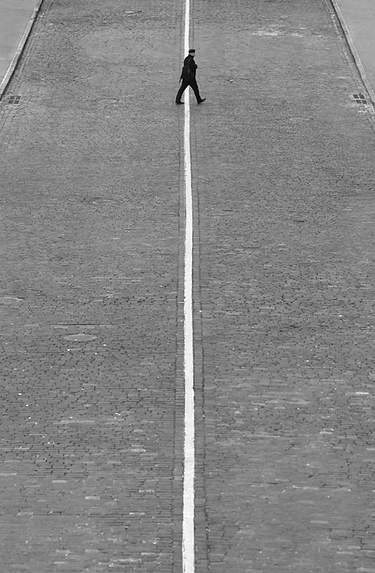
At first glance, boundaries there seem entirely clear. The rules are fixed. The lines are visible.
And yet — do we always want referees to apply the rules mechanically?
How often do people criticize a referee’s judgment?How often do we see referees deciding when to intervene and when to let the game continue?
Even in board games, many of us recognize the temptation to bend the rules slightly — to exchange a card quietly, to move one step too far, to ignore a small violation.
These are examples of what I think of as “thin boundaries.”
Thin boundaries make it very clear when someone has crossed from one side to another. You are either inside or outside. With us or against us.
Thin boundaries often preserve stability more effectively. Totalitarian regimes, for example, tend to maintain extremely thin and rigid boundaries around movement, opinion, and belonging. There is little room for ambiguity or freedom within them.
Perhaps it is worth asking ourselves what kinds of boundaries we encounter in relation to different people, institutions, and systems in our lives. What does each boundary allow? And how do we feel in its presence?
Both wide and thin boundaries are necessary for human life.
But the real work often takes place at the boundary itself — in the encounter between closeness and separation, structure and freedom, self and other.
This is true in relationships, and perhaps even in our attempts to grow and change.
I would now like to say a few words about boundaries in psychotherapy.

Therapy relies heavily on boundaries. In psychodynamic language, this is often referred to as the “setting” — the stable structure surrounding the therapeutic encounter.
One of the clearest examples is time. Sessions begin and end at fixed hours.
At first glance, this rigidity may seem to contradict the openness and emotional freedom we hope to create within therapy.
But perhaps the opposite is true.
Clear boundaries serve at least two important functions.
The first is symbolic. Boundaries help create a protected container, suggesting that what happens within it is held, preserved, and taken seriously.
The second is more concrete. Clear boundaries allow both therapist and patient to notice the moments in which the boundary itself becomes emotionally meaningful.
Wanting to stay a few minutes longer. Arriving late. Asking to leave early.Testing the limits in subtle or direct ways.
When the boundary is stable and known to both sides, these movements around it can begin to say something about the relationship itself.
Because psychotherapy takes place within the uncertain territories between consciousness and unconsciousness, between closeness and distance, these seemingly thin boundaries can gradually create wider and more expansive spaces for thought, feeling, and human encounter.
If you are interested in exploring these ideas further, you can read more about our training in psychodynamic bibliotherapy at the Bibliotherapy Academy.
Comments